
The concept tau ‘mountain’ in the traditional culture of the Karachay-Balkars: word-forms, ideas, social regulation
DOI:
https://doi.org/10.25178/nit.2026.1.8EDN:
https://elibrary.ru/DSOFBZKeywords:
concept, tau, Karachays, Balkars, concept of culture, concept-as-idea, social regulationAbstract
The article analyzes the concept of tau ‘mountain’ in Karachay-Balkar ethnic culture. The study is based on an approach to the conceptualization of ethnoculture that presupposes examining the concept in three aspects: as a word-form, as an idea, and as a form of social regulation.
Accordingly, the concept tau is considered, first, from a linguistic perspective. Definitions of the word tau and its derivatives are analyzed, and verbal units correlated with the geomorphological feature of the mountain, which reflects the general notion of a mountain, are identified and systematized, along with linguistic means that represent mountain forms. The aspect of the concept-as-idea is examined through the specific features of the reflection of the mountain in culture in various contexts: mythological, religious, and spiritual.
These meanings with which the Karachays and Balkars endowed mountains, as well as their attitude toward them, determined specific forms of economic, ritual, and social life of mountain people. Social regulation of the concept was expressed overall in the formation of a moral and ethical code of conduct for members of the ethnic group.
The study shows that the mountain occupies a priority place in the life of the Karachay-Balkar people and constitutes a multifaceted geographical object correlated with a system of views, values, and traditions of the ethnos, which condition the regulation of social relations under harsh natural and climatic conditions.
References
Abaev, M. K. (1992) Historical sketch: Balkaria. Nalchik, Elbrus. 43 p. (In Russ.)
Aglarov, M. A. (1984) Pagan sanctuary on the top of Mount Bakhargan. In: Ch. S. Yusupova (ed.) Mythology of the peoples of Dagestan: collection of articles. Makhachkala, G. Tsadasa Institute of Language, Literature and Art of the Dagestan Scientific Centre of RAS. 187 p. Pp. 36–43. (In Russ.)
Akhmatova, M. A. (2015) The concept “Mountain” in the Karachay-Balkar Nart epic. Sovremennye problemy nauki i obrazovaniya, part 3, p. 68. (In Russ.)
Batomunkueva, S. R. (2019) The cult of mountains in the socio-cultural space. Chronos, no. 9 (36), pp. 46–49. (In Russ.)
Bashieva, S. K. and Bakhtikireeva, U. M. (2025) Karachay-Balkar toponymy as a means of cumulation and preservation of ethnocultural information. New Research of Tuva, no. 2, pp. 280–289. (In Russ.) DOI: https://doi.org/10.25178/nit.2025.2.16
Bashieva, S. K., Gelyaeva, A. I. and Kuchukova, Z. A. (2011) Meanings and images of space and time in the system of ethnic identity. Filosofskie nauki, no. S1, pp. 87–107. (In Russ.)
Bizheva, Z. Kh., Makitova, T. T. and Mokaeva, I. R. (2024) Linguocultural type “modern Caucasian mountaineer”. Kazanskaya nauka, no. 10, pp. 430–433. (In Russ.)
Blagova, G. F. (2006) The anthroponymic system as a projection of the cosmological and social views of the Proto-Turks. In: E. R. Tenishev and A. V. Dybo (eds) Comparative-historical grammar of the Turkic languages. Proto-Turkic language – the basis. The worldview of the Proto-Turkic ethnos according to linguistic data. Moscow, Nauka. 908 p. Pp. 660–765. (In Russ.)
Dzhurtubaev, M. Ch. (2011) Mythology and epic of the Karachay-Balkar people: Ancient beliefs of the Balkars and Karachays. Karachay-Balkar heroic epic. Nalchik, Elbrus. 488 p. (In Russ.)
Zalikhanov, M. Ch. (2020) Elbrus and science. 85 years of the High-Mountain Geophysical Institute of Roshydromet and RAS. Moscow, Russian Academy of Sciences. 728 p. (In Russ.)
Ketenchiev, M. B. and Appoev, A. A. (2023) Names of dances in the Karachay-Balkar language: etymological studies. Nauchnaya mysl Kavkaza, no. 1(113), pp. 131–137. (In Russ.)
Kuznetsov, V. A. (1962) Alan tribes of the North Caucasus. Moscow, Publishing House of the Academy of Sciences of the USSR. 137 p. (In Russ.)
Lamazhaa, Ch. K. (2023) Cultural concepts: form, idea, social regulation. New Research of Tuva, no. 1, pp. 6–25. (In Russ.) DOI: https://doi.org/10.25178/nit.2023.1.1
Musukov, B. A., Ulakov, M. Z. and Makhieva, L. Kh. (2021) Lexico-semantic and syntagmatic features of Turkic geographical names and appellative lexemes. Izvestiya Kabardino-Balkarskogo nauchnogo tsentra RAN, no. 4 (102), pp. 80–89. (In Russ.)
Potapov, L. P. (1946) The cult of mountains in Altai. Sovetskaya etnografiya, no. 2, pp. 145–160. (In Russ.)
Sagalaev, A. M. (1991) Ural–Altaic mythology. Symbol and archetype. Novosibirsk, Nauka, Siberian Branch. 155 p. (In Russ.)
Sarbashyeva, A. M. (2009) Balkar drama: ethnofolklore tradition and evolution of the genre. Nalchik, KBIHI Publishing House. 240 p. (In Russ.)
Semenov, A. V. (2010) Mountain sanctuaries of Tuva. Vestnik Sankt-Peterburgskogo universiteta. Seriya 2: Istoriya, issue 4, pp. 140–146. (In Russ.)
Seferbekov, M. R. (2015) The cult of Caucasian mountains. Vestnik Dagestanskogo gosudarstvennogo universiteta, vol. 30, issue 4, pp. 18–23. (In Russ.)
Stepanov, Yu. S. (1997) Constants: a dictionary of Russian culture. Research essay. Moscow, Yazyki russkoy kultury. 824 p. (In Russ.)
Toporov, V. N. (2010a) The world tree: Universal sign complexes: in 2 vol. Moscow, Rukopisnye pamyatniki Drevney Rusi. Vol. 1. 448 p. (In Russ.)
Toporov, V. N. (2010b) The world tree: Universal sign complexes: in 2 vol. Moscow, Rukopisnye pamyatniki Drevney Rusi. Vol. 2. 496 p. (In Russ.)
Khapaev, S. A. (2013) Geographical names of Karachay and Balkaria. Moscow, KosmoPoligraf. 576 p. (In Russ.)
Khubolov, S. M., Tekuev, M. M. and Akhmatova, M. A. (2024) Structural and semantic features of figurative expressions characterizing Mount Elbrus in the Karachay-Balkar language. Filologicheskie nauki. Voprosy teorii i praktiki, vol. 17, issue 3, pp. 918–923. (In Russ.)
Shogenova, M. Ch. (2015) Ethnocultural image of a linguistic personality in endoethnonyms. Filologicheskie nauki. Voprosy teorii i praktiki, no. 8(50), part 3, pp. 211–214. (In Russ.)
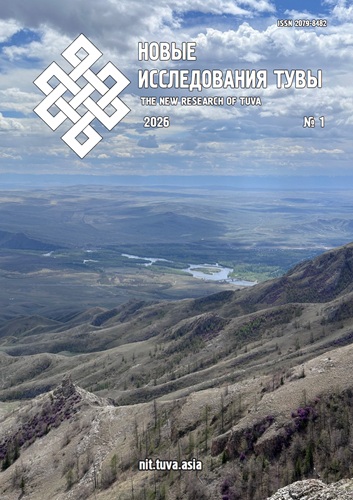
Downloads
Published
Issue
Section
How to Cite
For citation:
Bashieva S. K. The concept tau ‘mountain’ in the traditional culture of the Karachay-Balkars: word-forms, ideas, social regulation. New Research of Tuva, 2026, no. 1, pp. 151-165 (In Russ.). DOI: https://doi.org/10.25178/nit.2026.1.8
Author Biography
-
Svetlana K. Bashieva Kabardino-Balkarian State University named after Kh. M. Berbekov

Doctor of Philology, Professor, Head, Department of Russian Language and General Linguistics, Kabardino-Balkarian State University named after Kh. M. Berbekov.
Postal address: 173 Chernyshevskogo St., 360004, Nalchik, Russian Federation.
E-mail: bfo-pdo@mail.ru
Supporting Agencies
License
Copyright (c) 2026 New Research of Tuva (edition)

This work is licensed under a Creative Commons Attribution-NonCommercial 4.0 International License.
Author(s) license holder(s) grant rights for their work to the journal (grantee of a license) under the simple non-exclusive open license in accordance with Art. 1286.1 «Open license for a research work, work of literature or fine arts», Civil Code of the Russian Federation.
New Research of Tuva publishes articles under the Creative Commons Attribution-NonCommercial license (CC BY-NC).
Since it is an open license, author(s) reserve the right to upload the article to their institutional repository, submit it to another journal (if it allows republications), or republish it on their own website (in full, or in part).
However, several conditions apply here:
a) The republished version must always contain the name(s) and affiliation(s) of the author(s), the original title and the hyperlink to the original version on the New Research of Tuva website;
b) It must be in open access, free of charge, and no category of readers must be in any way whatsoever advantaged over general readership.
c) should the contribution be submitted elsewhere by its author(s) without substantial modification (30% or more of original text unchanged), the body of the article should contain a disclaimer that the original version was published in New Research of Tuva (with a link to the respective page)
The CC-BY-NC is a non-revocable license which applies worldwide and lasts for the duration of the work’s copyright.