
Multispecies Relations in Nomadic Society: Theoretical and Methodological Approaches
DOI:
https://doi.org/10.25178/nit.2026.2.20Keywords:
multispecies kinship, Tuva, horse, animal agency, social landscape, responsible guesting, reviewAbstract
The article presents an analysis of the monograph by anthropologist V. Peemot, The Horse in My Blood: Multispecies Kinship in the Altai and Sayan Mountains, published in 2024 by Berghahn Books. The monograph examines how Turkic-speaking populations of the Sayan-Altai region construct their relationships with native landscapes and horses, which are perceived as part of an extended circle of kinship. The author describes how these relationships are enacted in everyday practices, rituals, and lived experiences of coexistence.
The reviewers pay particular attention to the phenomena described by V. Peemot, including multispecies kinship, animal agency, and the social animacy of the landscape. These vectors are selected due to their significant scholarly relevance, as they remain insufficiently developed and methodologically underexplored within contemporary Russian ethnography. The authors emphasize Peemot’s argument that the concept of multispecies kinship implies a departure from traditional economic and symbolic interpretations of animals, instead revealing a stable co-existence of humans and horses as subjects within kin relations.
According to the reviewers, the author rightly assigns considerable importance to the category of “cher törel” as a local form of animistic ontology, in which mountains, rivers, and pastures are perceived as animate relatives participating in the fate of the kin group. It is noted that attention to this category expands the analytical framework of Russian ethnography by enabling the inclusion of landscape within systems of social relations. A particular strength of the monograph is identified in the author’s engagement with the concept of “aaldaar”, interpreted as an ethical foundation for field research. The advantages of this approach, especially its depth of immersion, are discussed, while also highlighting epistemological risks associated with the potential subjectivization of research material.
References
Altai. The Pearl and Heart of Eurasia (2010) / comp. S. M. Burygin. Moscow, Veche. 288 p. (In Russ.)
Burnakov, V. A. (2024) The image of the “horse–human” in the traditional worldview of the Khakas people (late 19th–20th century), Tomsk Journal of Linguistic and Anthropological Studies, no. 2 (44), pp. 84–93. (In Russ.)
Vainshtein, S. I. (1961) Tuvans-Todzhans: Historical and ethnographic essays. Moscow, Publishing House of Oriental Literature. 218 p. (In Russ.)
Vainshtein, S. I. (1972) Historical ethnography of the Tuvans: Problems of nomadic economy. Moscow, Nauka, 314 p. (In Russ.)
Gromov, G. G. (1966) Methods of ethnographic expeditions. Moscow, Moscow State University. 107 p. (In Russ.)
Darzha, V. K. (2014) The horse in the traditional practice of Tuvan nomads. Kyzyl, Tuvan Book Publishing House. 154 p. (In Russ.)
Dyrenkova, N. P. (2012) The Turks of the Sayan-Altai. Articles and ethnographic materials. Saint Petersburg, Museum of Anthropology and Ethnography RAS. 408 p. (In Russ.)
Zhdanko, T. A., Krupyanskaya, B. Yu. and Terentyeva, L. N. (1956) On the organization and methods of field ethnographic research. Sovetskaya etnografiya, no. 3, pp. 25–34. (In Russ.)
Iokhelson, V. I. (2023) Field diaries from the Sibiryakov (Yakut) expedition. Moscow, Nauka – Vostochnaia literature. 214 p. (In Russ.)
Kuzhuget, Sh. Yu. (2023) The Tuvans’ attitude to land in Tuvan literature of the 20th–21st centuries. New Research of Tuva, no. 1, pp. 64–79. (In Russ.) DOI: https://doi.org/10.25178/nit.2023.1.4
Lamazhaa, Ch. K. (2011) Tuva between the past and the future. Saint Petersburg, Aleteiia. 368 p. (In Russ.)
Lamazhaa, Ch. K., Suvandii, N. D. and Mongush, A. V. (2023) The sacred in Tuvan culture: past and present. New Research of Tuva, no. 3, pp. 220–241. (In Russ.) DOI: https://doi.org/10.25178/nit.2023.3.14
Mainy, Sh. B. (2023) Conceptions of cher ‘land’ among contemporary Tuvans. New Research of Tuva, no. 1, pp. 38–63. (In Russ.) DOI: https://doi.org/10.25178/nit.2023.1.3
Potapov, L. P. (1953) Essays on the history of the Altai people. Moscow, Leningrad, Publishing House of the Academy of Sciences of the USSR. 444 p. (In Russ.)
Potapov, L. P. (1969) Essays on the traditional life of the Tuvans. Moscow, Nauka. 402 p. (In Russ.)
Sanchai, Ch. Kh. (2023) Images of native land in the musical and song culture of the Tuvans. New Research of Tuva, no. 1, pp. 80–109. (In Russ.) DOI: https://doi.org/10.25178/nit.2023.1.5
Suvandii, N. D. (2023) Cher ‘land’ in Tuvan paremias. New Research of Tuva, no. 1, pp. 26–37. (In Russ.) DOI: https://doi.org/10.25178/nit.2023.1.2
Tuva: Native land (2023) / eds by Ch. K. Lamazhaa and N. D. Suvandii. Saint Petersburg, Nestor-Istoriia, 340 p. (In Russ.)
Tuvans: Native people (2022) / eds by Ch. K. Lamazhaa and N. D. Suvandii. Saint Petersburg, Nestor-Istoriia, 344 p. (In Russ.)
Turkic peoples of Eastern Siberia (2008) / eds by D. A. Funk and N. A. Alekseev. Moscow, Nauka. 422 p. (In Russ.)
Uvarova, T. B. (2020) From the history of Russian ethnology: researchers, projects, methods. Sotsialnye i gumanitarnye nauki. Otechestvennaya i zarubezhnaya literatura. Seriya 5: Istoriya, no. 3, pp. 160–173. (In Russ.)
Ushnitskii, V. V. (2017) Northern nomads: interaction between humans and horses in Yakut culture. Izvestiia Irkutskogo gosudarstvennogo universiteta. Seriia: Geoarkheologiia. Etnologiia. Antropologiia, vol. 19, pp. 172–183. (In Russ.)
Filippova, V. V. (2012) The image of the horse in the folklore and traditional culture of the Yakuts. Diskussiia, no. 2, pp. 33–35. (In Russ.)
Forum: Humans and other living beings (2024). Antropologicheskii forum, no. 62, pp. 11–224. (In Russ.) DOI: https://doi.org/10.31250/181588702024206211224
Ethnography of the peoples of Altai and Western Siberia (1978): collection of articles / ed. by A. P. Okladnikov. Novosibirsk, Nauka, Siberian Branch. 222 p. (In Russ.)
Haraway, D. J. (2008) When species meet. Minneapolis, MN., University of Minnesota Press. 423 р.
Ingold, T. (2000) The Perception of the Environment: Essays on Livelihood, Dwelling and Skill. London; New York, Routledge. 485 p.
Peemot, V. S. (2024) The Horse in My Blood: Multispecies Kinship in the Altai and Saian Mountains. New York & Oxford, Berghahn Books. 210 p. DOI: https://doi.org/10.3167/9781805392958
Rasiulis, N. (2025) Review of The Horse in My Blood: Multispecies Kinship in the Altai and Sayan Mountains by V. Soyan Peemot. Sibirica, vol. 24(2), pp. 100–101.
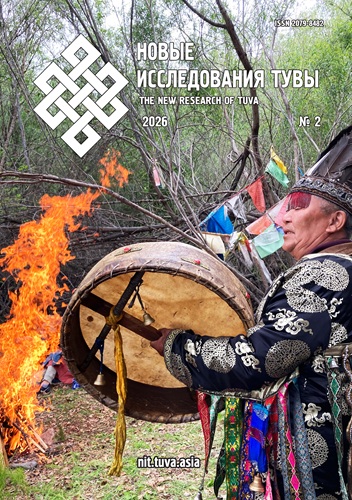
Downloads
Published
Issue
Section
How to Cite
For citation:
Makarchuk I. Yu. and Mamysheva E. P. Multispecies Relations in Nomadic Society: Theoretical and Methodological Approaches. New Research of Tuva, 2026, no. 2, pp. 320-331. (In Russ.). DOI: https://doi.org/10.25178/nit.2026.2.20
Author Biographies
-
Ivan Yu. Makarchuk Siberian Federal University
Doctor of Philosophy, Associate Professor, Professor at the Department of Philosophy, Siberian Federal University.
Postal address: 79 Svobodny Pr., 660041, Krasnoyarsk, Russia.
E-mail: imakarchuk@sfu-kras.ru
-
Elena P. Mamysheva Siberian Federal University; Tuvan State University

Doctor of Historical Sciences, Associate Professor, Professor at the Department of Russian History, World and Regional Civilizations, Siberian Federal University;
Professor at the Department of Theoretical, Public and Law Disciplines, Tuvan State University.
Postal addresses: 79 Svobodny Pr., 660041, Krasnoyarsk, Russia; 36 Lenina St., 667000, Kyzyl, Russia.
E-mail: sozor@mail.ru
License

This work is licensed under a Creative Commons Attribution-NonCommercial 4.0 International License.

Author(s) license holder(s) grant rights for their work to the journal (grantee of a license) under the simple non-exclusive open license in accordance with Art. 1286.1 «Open license for a research work, work of literature or fine arts», Civil Code of the Russian Federation.
New Research of Tuva publishes articles under the Creative Commons Attribution-NonCommercial license (CC BY-NC).
Since it is an open license, author(s) reserve the right to upload the article to their institutional repository, submit it to another journal (if it allows republications), or republish it on their own website (in full, or in part).
However, several conditions apply here:
a) The republished version must always contain the name(s) and affiliation(s) of the author(s), the original title and the hyperlink to the original version on the New Research of Tuva website;
b) It must be in open access, free of charge, and no category of readers must be in any way whatsoever advantaged over general readership.
c) should the contribution be submitted elsewhere by its author(s) without substantial modification (30% or more of original text unchanged), the body of the article should contain a disclaimer that the original version was published in New Research of Tuva (with a link to the respective page)
The CC-BY-NC is a non-revocable license which applies worldwide and lasts for the duration of the work’s copyright.