
Mountain Country — The Culture of Mountains
DOI:
https://doi.org/10.25178/nit.2026.1.1EDN:
https://elibrary.ru/CPTKFPKeywords:
Tuva, Tuvans, dag, tau, mountain, concept of culture, mountain vocabulary, image of the mountain, social regulation, ritual, dagylga, Turkic culture, Tuvan culture, ecological culture, Mountain studiesAbstract
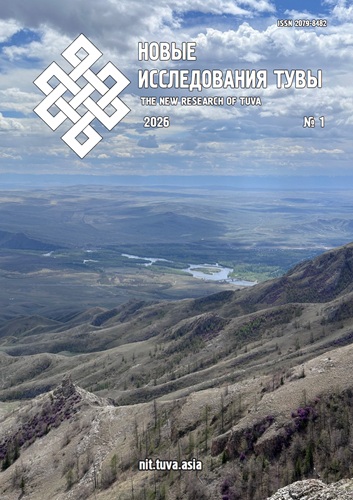
The article presents an interdisciplinary analysis of the concept “dag” (“mountain”) in the culture of the Tuvans and within the broader sociocultural space of Tuva. The natural landscape of the republic is predominantly mountainous, which determines the exceptional significance of mountains in the worldview and daily life of its inhabitants. The study draws on a wide range of sources, including lexicographic materials, folklore, fiction, scientific and local history publications, as well as media and online texts.
The authors approach “dag” as a key cultural concept encompassing three main aspects: mountain-related vocabulary and naming, the semantic meanings expressed in Tuvan representations, and social regulation manifested through practices, rituals, and social behavior. Special attention is given to the rich mountain terminology, which reflects the diversity of geographic forms, ecological norms, and mythological and ritual notions of mountains as living spirits and ancestors. The study demonstrates the persistence and revitalization of mountain veneration rituals (dagylga), as well as the influence of Buddhism and Soviet traditions on contemporary forms of interaction with mountain environments. Furthermore, the analysis considers toponyms, folklore texts, musical and artistic traditions that emphasize the central role of mountains in shaping Tuvan identity and locality.
The work reveals the multifaceted significance of mountains as natural, cultural, and spiritual phenomena that exert a profound influence on the sociocultural life of Tuva.
References
Аbaeva, L. L. (1991) Cult of mountains and Buddhism in Buryatia. Moscow, Nauka. 144 p. (In Russ.)
Alekseev, N. A. (1992) Traditional religious beliefs of the Turkic-speaking peoples of Siberia. Novosibirsk, Nauka, Siberian Branch. 242 p. (In Russ.)
Aminev Z. G. (2006) Cult of the sacred mountain Otukan of the ancient Turks and its traces among the Bashkirs. In: Problems of ethnogenesis and ethnic history of the Bashkir people: Proceedings of the All-Russian research and practice conference dedicated to the 70th anniversary of S. N. Shitova, Ufa, 22 December 2006 / ed. by F. G. Khisamitdinova et al. Ufa, Gilem Publishing House. 260 p. Pp. 26–29. (In Russ.)
Arakchaa, K. D., Kurbatskaya, S. S., Chupikova, S. A. (2024) Mountainous Tuva: state and development prospects. In: Kotlyakov V. M., Badenkov Yu. P. (eds) Mountain regions of Russia at the turn of the centuries. Research and development. Moscow, Media-PRESS. 560 p. Pp. 317–350. (In Russ.)
Badenkov, Yu. P. (2017) Life in the mountains. Natural and cultural diversity as a diversity of development models. Bishkek, University of Central Asia. 481 p. (In Russ.)
Badyrgy, M. M. (2023) Tuvan khoomei as an object of cultural policy. Kirov, Kirov Regional Printing House LLC. 232 p. (In Russ.)
Balakina, G. F., Chupikova, S.A. (2025) Mining tourism in the Republic of Tyva. Gornaya Promyshlennost, no. 6, pp. 216–219. (In Russ.) DOI: https://doi.org/10.30686/1609-9192-2025-6-216-219
Batomunkueva, S. R. (2019) Cult of mountains in the religious tradition of the Buryats. Ulan-Ude, Buryat Scientific Center of the Siberian Branch of the RAS. 154 p. (In Russ.)
Bashieva, S. K., Gelyaeva, A. I., Kuchukov,a Z. A. (2011) Meanings and images of space and time in the system of ethnic identity. Filosofskiyenauki. Special issue, no. 1, pp. 87–107. (In Russ.)
Gomboev, B. Ts. (2006) Cult places of the Barguzin Valley. Ulan-Ude, VSGAKI Publishing House. 287 p. (In Russ.)
Mountains and “mountain text” in the world historical and cultural process (2024): collection of research papers / ed. by N.O. Osipova. Budapest, Selmeczi Bt. (SBT) Publishing House; Kirov, Raduga-PRESS Publishing House LLC. 240 p. (In Russ.)
Dagylga: Tuvan consecration rituals in the 21st century (2021) / ed. by Ch. K. Lamazhaa, N. D. Suvandii. Kyzyl, s. n. 188 p. (In Russ.)
Darzha, V. K. (2007) Secrets of the worldview of Tuvan nomads. Kyzyl, s. n. 256 p. (In Russ.)
Dzhurtubaev, M. Ch. (2011) Mythology and epic of the Karachay-Balkar people: Ancient beliefs of the Balkars and Karachays. Karachay-Balkar heroic epic. Nalchik, Elbrus. 488 p. (In Russ.)
Dongak, A. S. (2018) Toponymic traditions and legends of South-Eastern Tuva. New Research of Tuva no. 3, pp. 126–147. (In Russ.) DOI: https://doi.org/10.25178/nit.2018.3.9
Dybo, A. V. (2005) Dental plosives in Proto-Turkic. In: Smirnov I. S. (ed.) Aspects of comparative studies. Vol. 1. Moscow, RGGU. 500 p. Pp. 49–82. (In Russ.)
Dyakonova, V. P. (1977) Religious cults of the Tuvans. In: Olderrogge D. A. (ed.) Monuments of culture of the peoples of Siberia and the North (second half of the 19th — early 20th centuries). Leningrad, Nauka, Leningrad Branch. Vol. 33. 231 p. Pp. 172–216. (In Russ.)
Zaika, V. V. (2020) The development of environmental studies in Tuva. New Research of Tuva no. 2, pp. 241–259. (In Russ.) DOI: www.doi.org/10.25178/nit.2020.2.17
Ivanova, E. E. (2023) On studying the mountain mythonymy of the Urals: mythonyms motivated by social vocabulary. Izvestia of the Ural Federal University. Series 2: Humanities, vol. 25, no. 4, pp. 234–250. (In Russ.) DOI: https://doi.org/10.15826/izv2.2023.25.4.071
Kara-ool, L. S. (2021) Confessional vocabulary in the toponyms of Tuva. New Research of Tuva no. 2, pp. 52–66. (In Russ.) DOI: https://doi.org/10.25178/nit.2021.2.5
Karelina, E. K. (2009) Music in the culture of post-Soviet Tuva. Izvestia of the A.I. Herzen Russian State Pedagogical University, issue 101, pp. 229–236. (In Russ.)
Kenin-Lopsan, M. B. (2006) Traditional culture of the Tuvans (translated from Tuvan). Kyzyl, Tuvan Book Publishing House. 230 p. (In Russ.)
Kisel, V. A. (2010) Ondum locality and a forgotten cult of Tuva. In: Fedorova E. G. (ed.) Siberian Collection–2: To the anniversary of Evgeniya Alekseevna Alekseenko. Saint Petersburg, MAE RAS. 320 p. Pp. 231–242. (In Russ.)
Kisel, V. A., Khavrin, S. V. (2009) Dogee Mountain as an archaeological and ethnographic monument of Tuva. New Research of Tuva no. 4, pp. 101–108. (In Russ.)
Kislova, G. I., Medyanik, O. V. (2004) Psychology of personality formation of a Caucasian mountaineer. Vestnik of Dagestan State University. Humanities, issue 3, pp. 50–54. (In Russ.)
Kolchikova, N. L., Prishchepa, V. P. (2020) An ethnopoetic approach to the study of contemporary literature of the Sayan-Altai region (on Tuvan and Khakas poetry). New Research of Tuva no. 3, pp. 210–227. (In Russ.) DOI: https://doi.org/10.25178/nit.2020.3.15
Konunov, A. A. (2010) Reflection of the cult of mountains in Altai heroic tales. Worldview of the population of Southern Siberia and Central Asia in historical retrospect, no. 4, pp. 335–341. (In Russ.)
Kuzhuget, A. K. (2006) Spiritual culture of the Tuvans: structure and transformation. Kemerovo, KemGUKI. 319 p. (In Russ.)
Kyzlasov, I. L. (1982) The ancestral-mountain in Khakas folklore. Sovetskaya Etnografiya, no. 2, pp. 83–92. (In Russ.)
Kyrgys, Z. K. (2002) Tuvan throat singing: an ethnomusicological study. Novosibirsk, Nauka. 236 p. (In Russ.)
Lamazhaа, Ch. K. (2023) Concepts of culture: form, idea, social regulation. New Research of Tuva, no. 1, pp. 6–25. (In Russ.) DOI: https://doi.org/10.25178/nit.2023.1.1
Lamazhaа, Ch. K., Kairzhanova, A. T. (2025) Bashky: address, mentoring and social relations. New Research of Tuva, no. 1, pp. 5–25. (In Russ.) DOI: https://doi.org/10.25178/nit.2025.1.1
Lamazhaа, Ch. K., Mainy, Sh. B. (2025) Knot of happiness in the socio-cultural space of Tuva. New Research of Tuva, no. 1, pp. 5–32. (In Russ.) DOI: https://doi.org/10.25178/nit.2025.2.1
Lamazhaа, Ch. K. (2021) Tuvan dagylga rituals in the 21st century. Etnograficheskoe Obozrenie, no. 2, pp. 125–143. (In Russ.) DOI: https://doi.org/10.31857/S086954150014811-2
Lamazhaа, Ch. K., Mainy, Sh. B., Sanchai, Ch. Kh., Suvandii, N. D. (2024) Ritual ribbons and flags in Tuvan culture. Kyzyl, Tuvan State University Publishing House. 195 p. (In Russ.)
Levin, T. (2012) Music of the new nomads. Throat singing in Tuva and beyond. Moscow, Klassika-XXI Publishing House. 336 p. (In Russ.)
Lopsan, M. M. (2011) The name of the forest in the Tuvan language in comparison with other Turkic languages. New Research of Tuva no. 4, pp. 189–196. (In Russ.)
Mainy, Sh. B. (2023) Notions of cher ‘earth’ among modern Tuvans. New Research of Tuva, no. 1, pp. 38–63. (In Russ.) DOI: https://doi.org/10.25178/nit.2023.1.3
Mainy Sh. B., Zeynebekova M. S. and Shaimerdenova M. Zh.(2026) Images of Mountains in the Song Culture of the Tuvans. New Research of Tuva, no. 1, pp. 60-82. (In Russ.). DOI: https://doi.org/10.25178/nit.2026.1.3
Nikolaev, E. R. (2018) Toponyms with the stem bash/bas in the Tuvan and Yakut languages: a linguoculturological interpretation. New Research of Tuva, no. 3, pp. 205–214. (In Russ.) DOI: https://doi.org/10.25178/nit.2018.3.13
Nikolaeva, E. K., Seliverstova, E. I., Lomakina, O. V., Suvandii, N. D. (2023) The image of the mountain in Tuvan paremias as a manifestation of ethnomarked mentality (against the background of Altai, Khakas, Buryat and Kalmyk proverbs). New Research of Tuva, no. 3, pp. 51–64. (In Russ.) DOI: https://doi.org/10.25178/nit.2023.3.4
Oorzhak, V. O. (2018) Extraction of Chonar-Dash: traditional technology and an element of the environmental culture of the Tuvans. New Research of Tuva no. 4, pp. 210–234. (In Russ.) DOI: https://doi.org/10.25178/nit.2018.4.12
Ochir-Garyaev, V. E. (1980) Cult of mountains among the Mongolic peoples. In: Erdniev U. E. (ed.) Issues of comparative ethnography and anthropology of the Kalmyks. Elista, Kalmyk Research Institute of History, Philology and Economics. 151 p. Pp. 135–143. (In Russ.)
Potapov, L. P. (1946) Cult of mountains in the Altai. Sovetskaya Etnografiya, no. 2, pp. 145–160. (In Russ.)
Potapov, L. P. (1969) Essays on the folk life of the Tuvans. Moscow, Nauka. 400 p. (In Russ.)
Natural and cult objects and archaeological sites of the Altai Republic (2015) / Ekeeva E. V., Konstantinov N. A., Konstantinova E. A., Ebel A. V. Gorno-Altaysk, s. n. 232 p. (In Russ.)
Prudnikova, T. N., Prudnikov, S. G., Kovaleva, O. V. (2021) Mineral resources and mining–metallurgical production of ancient Tuva. Prirodnyeresursy, sreda i obshchestvo, no. 4, pp. 6–26. (In Russ.)
Religious landscape of Western Siberia and adjacent regions of Central Asia (2014) / Dashkovskiy P. K. et al. Barnaul, Altai State University. 214 p. (In Russ.)
Saaya, O. M. (2018) Vocabulary of Buddhist cosmology in the Tuvan language. Filologicheskienauki. Voprosy teorii i praktiki no. 2, pp. 364–371. (In Russ.)
Samdan, Z. B. (2002) Poetics of the Tuvan myth. In: Mart-ool V. D. (ed.) Scholarly notes, vol. XIX / Tuvan Institute for Humanities Research. Kyzyl, Republican Printing House. 329 p. Pp. 235–246. (In Russ.)
Sanchai, Ch. Kh. (2023) Images of the native land in the musical and song culture of the Tuvans. New Research of Tuva no. 1, pp. 80–109. (In Russ.) DOI: https://doi.org/10.25178/nit.2023.1.5
Semenov, A. V. (2010) Mountain sanctuaries of Tuva. Vestnik of Saint Petersburg University. History no. 4, pp. 140–146. (In Russ.)
Seferbekov M.R. (2015) Cult of mountains among the peoples of the Caucasus. Vestnik of Dagestan State University, vol. 30, no. 4, pp. 18–23. (In Russ.)
Simchit, K.-M. A. (2018) The Old Turkic toponym Qadïrqan and its possible correspondences in the modern languages of the Sayan–Altai region. New Research of Tuva, no. 3, pp. 116–125. (In Russ.) DOI: https://doi.org/10.25178/nit.2018.3.8
Simchit, K.-M. A. (2025) On the oronym Tugluga and the microtoponymy of its surroundings. Aziatskie issledovaniya: istoriya i sovremennost, no. 1(13), pp. 80–94. (In Russ.)
Stepanov, Yu. S. (1997) Constants: Dictionary of Russian culture. Moscow, Shkola “Yazyki russkoy kultury”. 824 p. (In Russ.)
Suvandii, N. D. (2024) Holy toponyms of Tuva: lexico-semantic groups. New Research of Tuva no. 3, pp. 191–202. (In Russ.) DOI: https://doi.org/10.25178/nit.2024.3.11
Suvandii N. D. and Nurakhynova A. S. (2026) Myths, Legends and Traditions about the Names of Mountains among the Tuvans. New Research of Tuva, no. 1, pp. 105-117 (In Russ.). DOI: https://doi.org/10.25178/nit.2026.1.5
Traditional worldview of the Turks of Southern Siberia. Space and time. Material world (1988) / ed. by Gemuyev I. I. Novosibirsk, Nauka, Siberian Branch. 225 p. (In Russ.)
Tuva: Native land (2023) / Lamazhaa Ch. K., Suvandii N. D., Kuzhuget Sh. Yu. et al. Saint Petersburg, Nestor-Istoriya. 340 p. (In Russ.)
The Tuvans. Native people (2022)/ Lamazhaa Ch. K., Suvandii N. D., Kuzhuget Sh. Yu., Mainy Sh. B.; ed. by Lamazhaa Ch. K., Suvandii N. D. Saint Petersburg, Nestor-Istoriya. 360 p. (In Russ.)
Tuimebaev Zh. K., Mongush Sh. V. and Urazbayeva Zh. A. Mountain Toponyms in the “Toponymic Dictionary” by B. K. Ondar. New Research of Tuva, 2026, no. 1, pp. 37-59. (In Russ.). DOI: https://doi.org/10.25178/nit.2026.1.2
Ushnitsky, V. V. (2016) Genealogical legends of the ancient Turks-Ashina: she-wolf and doe-deer as totem ancestors. Problemy Vostokovedeniya, no. 3, pp. 30–35. (In Russ.)
Levin, T. (2010) Where Rivers and Mountains Sing: Sound, Music, and Nomadism in Tuva and Beyond. Bloomington, Indiana University Press. 312 p.
Mountain Studies. Understanding and Managing Mountains for People and Nature (2022) / ed. by Khan M. Z. et al. Islamabad, Minerva Advertising. 204 p.
Oelschlaegel, A. C. (2013) Plurale Weltinterpretationen. Das Beispiel der Tyva Südsibiriens. Fürstenberg/Havel, SEC Publications / Kulturstiftung Sibirien gGmbH. 268 p.
Pegg, C. (2024) Drones, Tones, and Timbres: Sounding Place among Nomads of the Inner Asian Mountain-Steppes. Champaign, University of Illinois Press. 344 p. DOI: https://doi.org/10.5622/illinois/9780252045455.001.0001
Veteto, J. (2009) From mountain anthropology to montology? An overview of the anthropological approach to mountain studies. In: Veress B., Szigethy J. (eds) Horizons in Earth Science Research. Vol. 1. New York, Nova Science Publishers, Inc. 229 p. Pp. 1–17.
Downloads
Published
Issue
Section
How to Cite
For citation
Lamazhaa Ch. K. and Mainy Sh. B. Mountain Country — The Culture of Mountains. New Research of Tuva, 2026, no. 1, pp. 6-36. (In Russ.). DOI: https://doi.org/10.25178/nit.2026.1.1Author Biographies
-
Chimiza K. Lamazhaa Kabardino-Balkarian State University, Al-Farabi Kazakh National University

Doctor of Philosophy, Visiting Professor, Kabardino-Balkarian State University;
Chief Researcher, Scientific Research Institute of Turkology and Altaic Studies, Al-Farabi Kazakh National University.
Postal addresses: 173 Chernyshevsky St., Nalchik, 360004, Russia; 71/27 Al-Farabi Ave., Almaty, 050000, Kazakhstan.
E-mail: lamazhaa@tuva.asia
-
Shenne B. Mainy Tuvan State University

Candidate of Cultural Studies, Senior Researcher, Laboratory of Ethnology and Linguoculturology, Tuvan State University.
Postal address: 9/B, Mongush Sat St., 667000 Kyzyl, Russia.
E-mail: shenne85@mail.ru
Supporting Agencies
License
Copyright (c) 2026 New Research of Tuva (edition)

This work is licensed under a Creative Commons Attribution-NonCommercial 4.0 International License.

Author(s) license holder(s) grant rights for their work to the journal (grantee of a license) under the simple non-exclusive open license in accordance with Art. 1286.1 «Open license for a research work, work of literature or fine arts», Civil Code of the Russian Federation.
New Research of Tuva publishes articles under the Creative Commons Attribution-NonCommercial license (CC BY-NC).
Since it is an open license, author(s) reserve the right to upload the article to their institutional repository, submit it to another journal (if it allows republications), or republish it on their own website (in full, or in part).
However, several conditions apply here:
a) The republished version must always contain the name(s) and affiliation(s) of the author(s), the original title and the hyperlink to the original version on the New Research of Tuva website;
b) It must be in open access, free of charge, and no category of readers must be in any way whatsoever advantaged over general readership.
c) should the contribution be submitted elsewhere by its author(s) without substantial modification (30% or more of original text unchanged), the body of the article should contain a disclaimer that the original version was published in New Research of Tuva (with a link to the respective page)
The CC-BY-NC is a non-revocable license which applies worldwide and lasts for the duration of the work’s copyright.