
Images of mountains in twentieth-century Tatar literature
DOI:
https://doi.org/10.25178/nit.2026.1.12EDN:
https://elibrary.ru/ZGSTHUKeywords:
mountain, mountain image, Tatar literature, Tatar language, twentieth-century literature, psychological proseAbstract
The article presents an analysis of works by Tatar writers and poets of the twentieth century from the perspective of the presence of mountain images in them. Although Tatarstan is a flat territory, mountains are of great importance for Tatar culture as images and symbols of a connection with the archaic past of its history and as a link with the mythological tradition of the Turkic-speaking people.
Mountain images, which were not characteristic of Tatar literature of previous centuries, began to appear in texts of the twentieth century. This is associated with two important periods in the history of national literature: the early twentieth century (intensification of the secularization of Tatar culture, the activation of dialogue with European and Russian literatures, the emergence of psychological prose, modernist tendencies) and the 1950s–1960s (a time of revival of national traditions and avant-garde experimentation).
It has been revealed that the formation of psychological prose in the early twentieth century, and the definition of the “stream of consciousness” as its main device, begins with the mountain image introduced by F. Amirkhan. In the 1950s, mountain images appear in the short stories of A. Eniki, where ethnic and universal values, the connection with historical and cultural traditions, and historical memory are examined. The work of this prose writer became one of the key factors that contributed to the emergence of national themes in Tatar Soviet literature. In the poems of R. Fayzullin, mountain images became emblematic image-symbols of the Tatar avant-garde of the 1960s–1980s.
References
Amineva, V. R. (2017) Ideological and artistic originality of A. N. Eniki’s hikayas of the 1940s–1960s. In: Amineva, V. R. (comp., anal. art.) Amirkhan Eniki. An unspoken will: short stories, novella. Kazan, Tatar book publishing house. 271 p. Pp. 123–196. (In Russ.)
Akhunov, G. (2002) Renewal. In: Mansurov, Z. (comp., introd.) Ravil Fai-zullin: epoch, creativity, personality. Kazan, Magarif. 495 p. Pp. 13–21. (In Ta-tar.)
Bakhtin, M. M. (1986) The aesthetics of verbal creativity. Moscow, Is-kusstvo. 444 p. (In Russ.)
Biguaa, V. A. (2021) Symbolic images of stone and mountains in the liter-atures of the peoples of Abkhazia and the North Caucasus. Studia Litterarum, vol. 6, no. 4, pp. 344–371. (In Russ.)
Galimullin, F. G. (2016) Tatar literature: a view through the centuries. Kazan, RITs “Shkola”. 295 p. (In Russ.)
Ganieva, A. F. and Nadyrshina, L. F. (2025) Features of the development of Tatar Soviet prose: thematic and poetic trends. New Research of Tuva, no. 3, pp. 94–111. (In Russ.) DOI: https://doi.org/10.25178/nit.2025.3.7
Davletshina, L. Kh. (2006) Mythologism in Tatar prose of the late 20th — early 21st centuries. Kazan, RITs “Shkola”. 140 p. (In Russ.)
Davletshina, L. Kh. (2022) Contemporary Tatar prose in the context of the current mythological tradition. Kazan, IyaLI. 312 p. (In Russ.)
Davletshin, G. M. (1999) History of the spiritual culture of the Turkic-Tatar people. Kazan, Tatarstan kitap nashriyaty. 512 p. (In Tatar.)
Zagidullina, D. F. (2013) Modernism in Tatar literature of the first third of the 20th century. Kazan, Tatar book publishing house. 207 p. (In Russ.)
Zagidullina, D. F. (2015) Tatar literature of the 1960s — 1980s: fields of renewal and avant-garde searches. Kazan, Tatar. kit. nashr. 383 p. (In Tatar.)
Ibragimov, M. I. and Zagidullina, D. F. (2024) Tatar literature of the early 20th century through the prism of G. D. Gachev’s theory of accelerated develop-ment of literatures. New Research of Tuva, no. 4, pp. 127–137. (In Russ.) DOI: https://doi.org/10.25178/nit.2024.4.9
Yosypova, N. M. (2021) Tatar poetry of the second half of the 20th centu-ry: traditions and innovation. Kazan, RITs “Shkola”. 296 p. (In Tatar.)
Klyashtornyi, S. G. (1979) Ancient Turkic mythology: towards a problem statement. In: Petrosyan, Yu. A. (ed.) Written monuments and problems of the history of culture of the peoples of the East: in 2 parts. Moscow, Nauka. Part 2. 107 p. Pp. 91–96. (In Russ.)
Losev, A. F. (1982) Sign. Symbol. Myth. Moscow, Moscow University Press. 480 p. (In Russ.)
Lotman, Yu. M. (2000) The semiosphere. St Petersburg, Iskusstvo-SPb. 704 p. (In Russ.)
Nadyrshina, L. R. (2022) The poem in 20th-century Tatar literature. Ka-zan, G. Ibragimov Institute of Language, Literature and Art. 352 p. (In Russ.)
Khatipov, F. and Sverigin, R. (2009) Amirkhan Eniki. Kazan, TGGPU. 114 p. (In Russ.)
Downloads
Published
Issue
Section
How to Cite
For citation:
Zagidullina D. F., Makarova V. F. and Minnullin K. M. Images of mountains in twentieth-century Tatar literature. New Research of Tuva, 2026, no. 1, pp. 200-217 (In Russ.). DOI: https://doi.org/10.25178/nit.2026.1.12
Author Biographies
-
Daniya F. Zagidullina G. Ibragimov Institute of Language, Literature and Art, Tatarstan Academy of Science
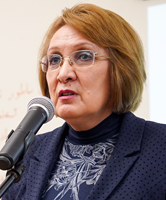
Doctor of Philology, Chief Researcher, Literary Studies Department, G. Ibraghimov's Institute of Language, Literature and Arts, Academy of Sciences, Republic of Tatarstan.
Postal address: 20 Baumana St., 420111, Kazan, Russia.
E-mail: zagik63@mail.ru
-
Venera F. Makarova G. Ibragimov Institute of Language, Literature and Art, Tatarstan Academy of Science

Doctor of Philology, Leading Researcher, Department of Literary Studies, G. Ibragimov Institute of Language, Literature and Art, Tatarstan Аcademy of Sciences.
Postal address: 20 Baumana St., 420111, Kazan, Russia.
E-mail: makarova_vf@mail.ru
-
Kim M. Minnullin G. Ibragimov Institute of Language, Literature and Art, Tatarstan Academy of Science

Doctor of Philology, Chief Researcher, Department of Folklore Studies, G. Ibragimov Institute of Language, Literature and Art, Tatarstan Аcademy of Sciences.
Postal address: 20 Baumana St., 420111, Kazan, Russia.
E-mail: minnullin.kim@yandex.ru
License
Copyright (c) 2026 New Research of Tuva (edition)

This work is licensed under a Creative Commons Attribution-NonCommercial 4.0 International License.

Author(s) license holder(s) grant rights for their work to the journal (grantee of a license) under the simple non-exclusive open license in accordance with Art. 1286.1 «Open license for a research work, work of literature or fine arts», Civil Code of the Russian Federation.
New Research of Tuva publishes articles under the Creative Commons Attribution-NonCommercial license (CC BY-NC).
Since it is an open license, author(s) reserve the right to upload the article to their institutional repository, submit it to another journal (if it allows republications), or republish it on their own website (in full, or in part).
However, several conditions apply here:
a) The republished version must always contain the name(s) and affiliation(s) of the author(s), the original title and the hyperlink to the original version on the New Research of Tuva website;
b) It must be in open access, free of charge, and no category of readers must be in any way whatsoever advantaged over general readership.
c) should the contribution be submitted elsewhere by its author(s) without substantial modification (30% or more of original text unchanged), the body of the article should contain a disclaimer that the original version was published in New Research of Tuva (with a link to the respective page)
The CC-BY-NC is a non-revocable license which applies worldwide and lasts for the duration of the work’s copyright.